Abstract
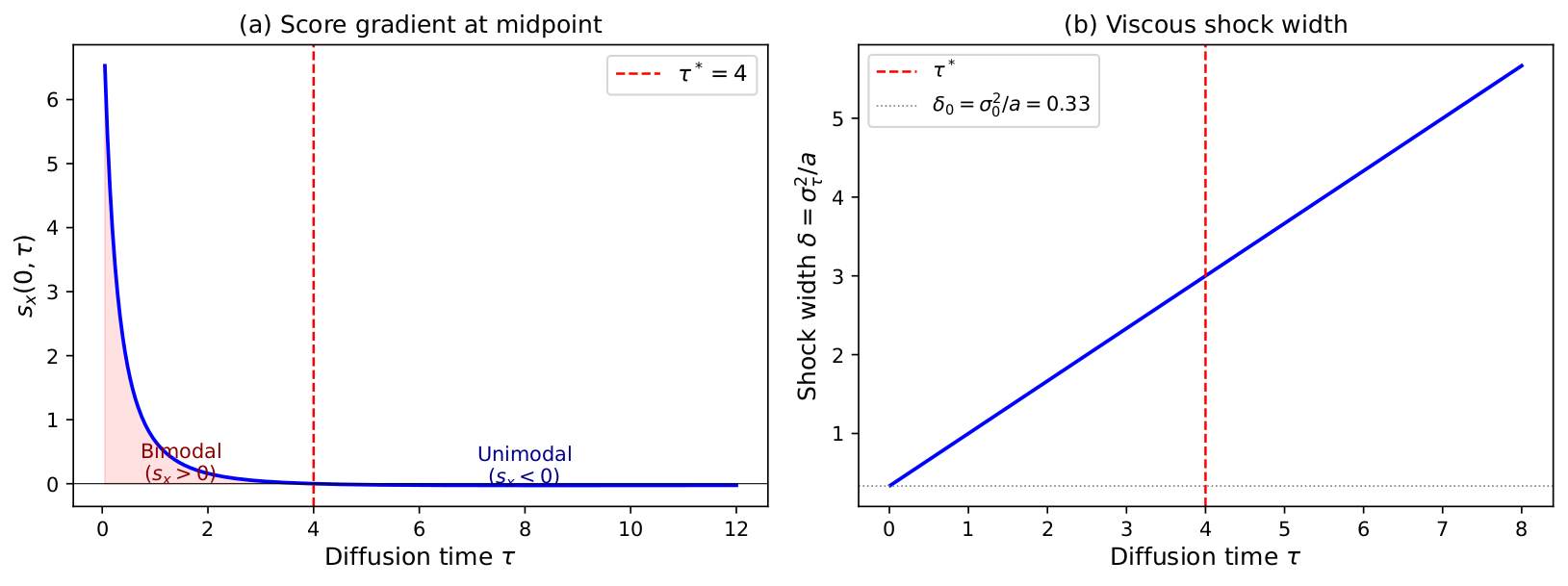
We analyze the score field of a diffusion generative model through a Burgers-type evolution law. For Variance Exploding (VE) diffusion, the heat-evolved data density implies that the score obeys the viscous Burgers equation in one dimension and the corresponding irrotational vector Burgers system in \(\mathbb{R}^d\). This provides a PDE-based perspective on speciation transitions—the sharpening of inter-mode interfaces during the reverse diffusion process. We derive a universal tanh interfacial profile for binary mixtures and establish a normal criterion for speciation that aligns with recent spectral threshold theories.
The Score-Burgers Correspondence
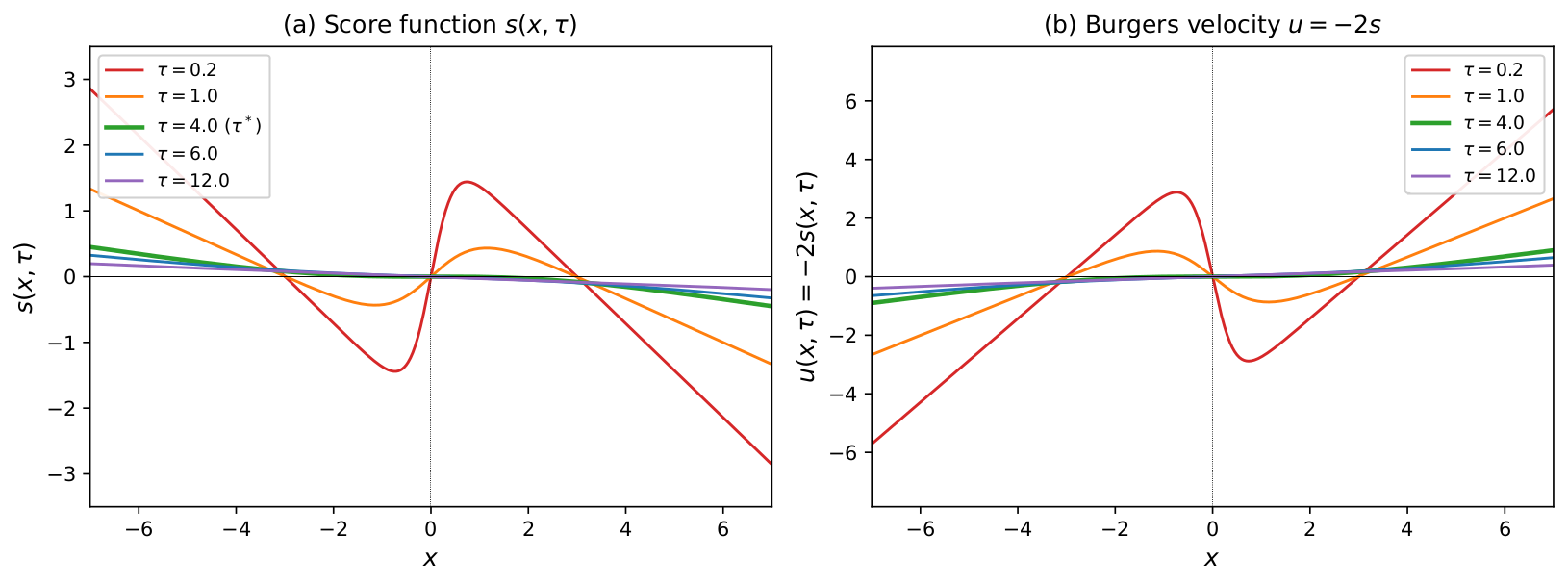
The fundamental insight of this work is that the score function \(s(x, \tau) = \nabla \log p_\tau(x)\) of a VE diffusion process satisfies a nonlinear PDE.
Interfacial Structure & Speciation
Near the boundary between two data modes, the score field exhibits a universal structure. We show that for any binary decomposition of the noised density, the score separates into a smooth background and a tanh interfacial term.
Key Mathematical Results
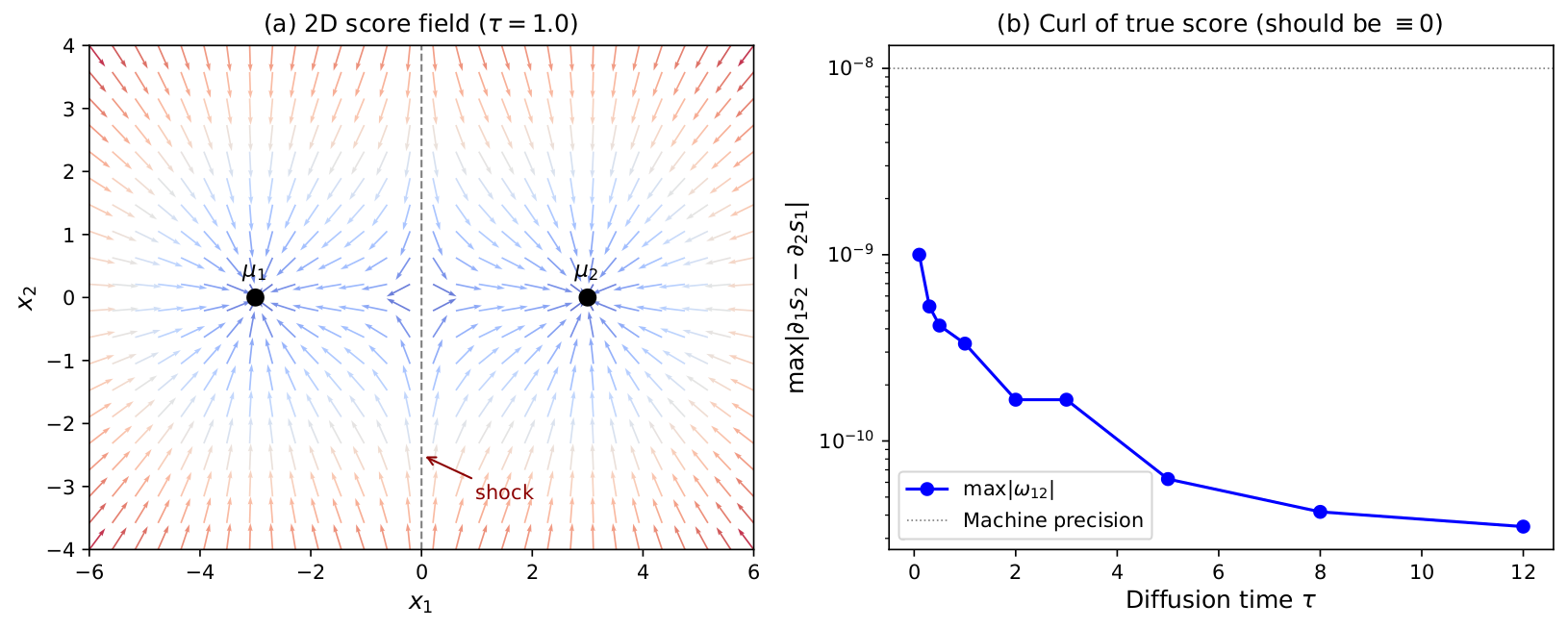
1. Preservation of Irrotationality
We prove that if the initial score field is a gradient (irrotational), the Burgers-type evolution preserves this property for all \(\tau > 0\). This ensures the score remains the gradient of a log-density.2. Error Amplification
We quantify the exponential amplification of score estimation errors across the shock layer. This explains why diffusion models often struggle with high-fidelity generation near mode boundaries.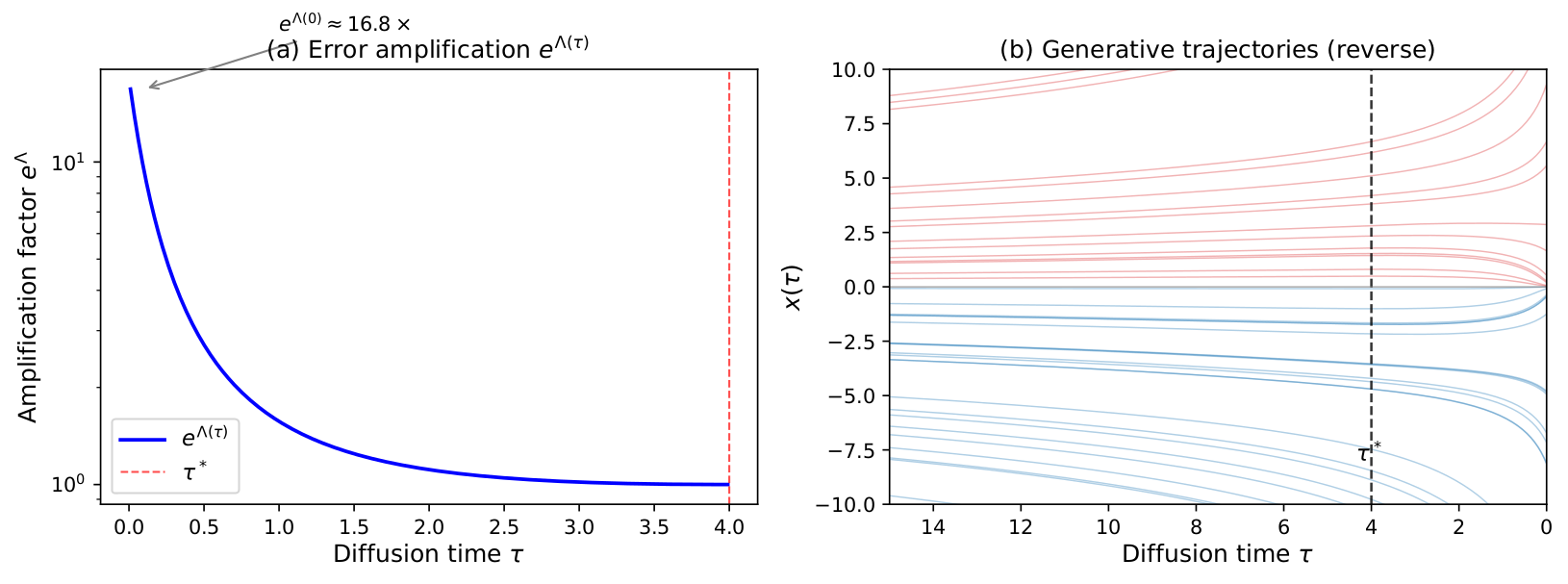
Numerical Verification
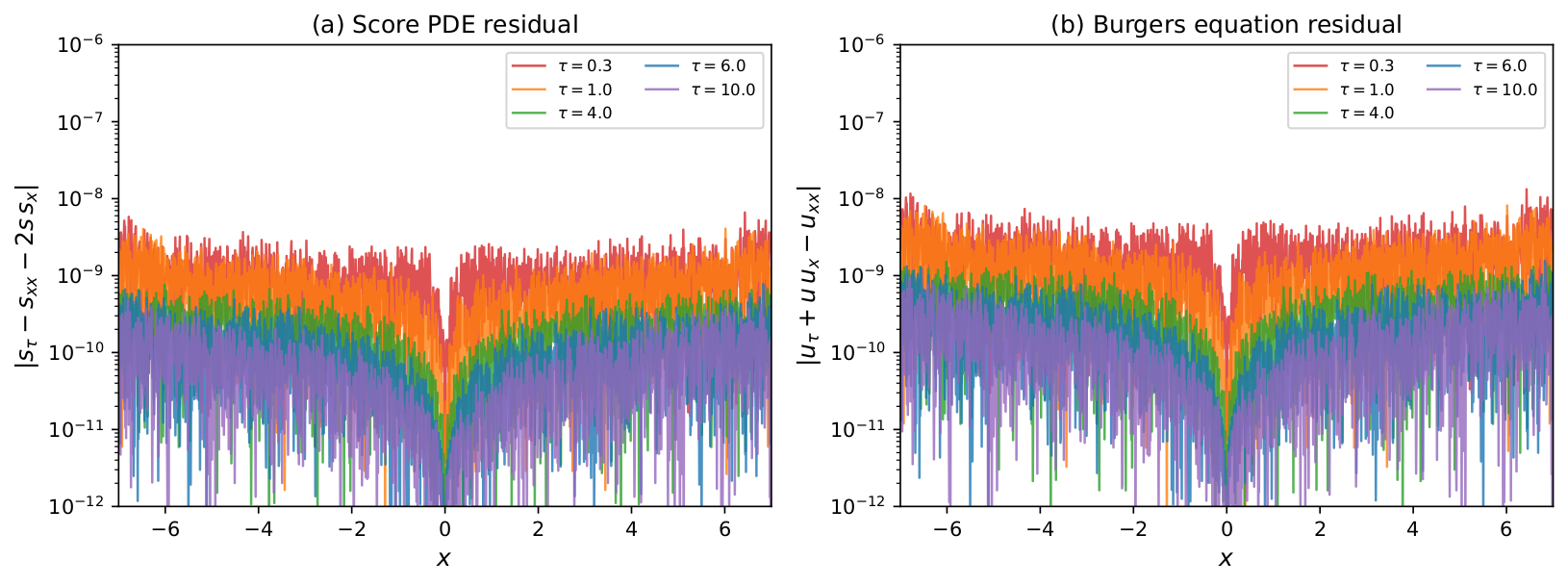
The theoretical results are verified using both synthetic Gaussian mixtures and complex potential wells.
Conclusion
By establishing a formal link between Diffusion Generative Models and Burgers Equation dynamics, this work provides a rigorous framework for understanding how these models represent and separate data modes. The "Score Shock" perspective offers new tools for analyzing model stability, error propagation, and the fundamental limits of score-based sampling.